Carpet beetles and their larvae are one of the most destructive fabric pests in Philadelphia homes. Learn to identify adults, larvae, and damage before it's too late.
📷 Text Us a Photo FreeText your bug photo to (215) 274-0754 and get a response from a pest expert within minutes.
Upload a photo and chat live with a pest identification expert from City Best Pest Control.
Email your photo to info@citybestpestcontrol.com with your location and we will identify it fast.
Carpet beetle larvae cause all the fabric damage — adults are harmless pollen feeders. Identifying the larva stage is critical since that's what destroys wool, silk, fur, and natural fiber garments.
White, 0.35mm, oval. Laid singly in lint, fabric folds, or natural fiber items. Hatch in 6-16 days depending on temperature. A female lays 40-90 eggs.
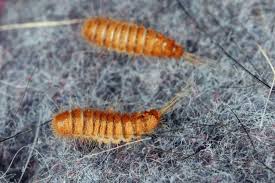
4-7mm, banded brown with distinctive tail bristles and lateral setae. The destructive stage — feeds on wool, feathers, silk, fur, and stored foods. Larval stage lasts 7-30 months.
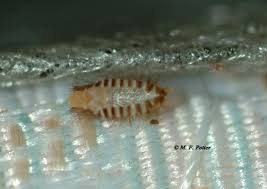
The most common sign of infestation — hollow, bristled shed skins (exuviae) found in closets, under rugs, and in air vents. Often mistaken for live insects.
Pupation occurs within the last larval skin. Cream to light tan. Does not feed. Adults emerge in 6-24 days. Pupae found in fabric damage locations or adjacent cracks.
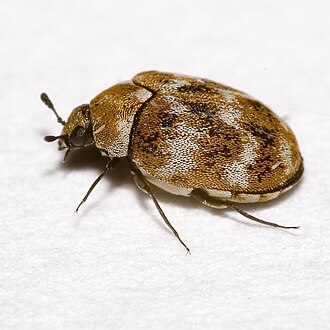
2-3mm, rounded, mottled black/white/yellow/orange scales. Feeds on pollen outdoors. Enters homes through windows and on cut flowers. Does NOT damage fabric as an adult.
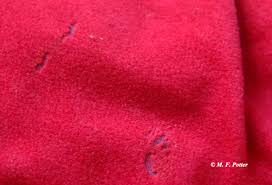
Surface feeding creates irregular bare patches with undamaged base threads still present. Damage concentrated in dark, undisturbed areas — back of closets, under furniture, in stored clothing.
Images: Wikimedia Commons — free educational use
Original scientific illustrations — adults (top) and larvae (bottom)
Varied Carpet Beetle
2-3mm • Mottled white, brown & yellow scales • Round
Anthrenus verbasci
Black Carpet Beetle
3-5mm • Solid shiny black • Elongated oval
Attagenus unicolor
Furniture Carpet Beetle
2-3.5mm • White & orange scales, black spots • Very round
Anthrenus flavipes
⚠ If larvae are hairy/bristly = carpet beetle. If smooth = bed bug nymph.
Varied Carpet Beetle Larva
Up to 5mm • Brown banded • Carrot-shaped • Bristle tufts at tail
Black Carpet Beetle Larva
Up to 12mm • Golden-brown • Elongated • Long golden tail tuft
Furniture Carpet Beetle Larva
Up to 4mm • White/tan banded • Dense bristly setae covering body
Scientific illustrations by Philadelphia Insect Identification — not to scale
Adult carpet beetles are small, oval-shaped insects. Philadelphia homes host three main species, each with distinct markings:
Adult carpet beetles are often first noticed on windowsills in spring — they are attracted to light and seek to fly outdoors to feed on pollen. Seeing adults near windows is a sign that larvae are actively feeding somewhere in your home.
⚠ Larvae cause the damage — not adults. This is the stage to watch for.
Carpet beetle larvae are frequently mistaken for baby bed bugs. Key difference: larvae are fuzzy/hairy with visible hair tufts. Bed bug nymphs are smooth and translucent. If you find a hairy brown larva, it is almost certainly a carpet beetle.
Brown, shell-like cast skins (exuviae) are the most reliable sign. Look in dark corners, under furniture, inside closets and drawers.
Irregular holes in wool carpets, clothing, blankets, and upholstery. Damage follows fibers rather than cutting across weave (unlike moths).
Slow-moving hairy brown larvae in dark undisturbed areas: under furniture, in closet corners, inside stored boxes of fabric.
Tiny pepper-like fecal pellets the same color as the material being consumed, found near feeding sites.
Bald patches on wool rugs or furs where larvae have fed along the base of fibers near the backing.
Small round beetles crawling on windowsills in spring indicate an active indoor population somewhere in the home.
Philadelphia's older housing stock — Victorian rowhouses, pre-war apartments, and historic single-family homes — often contains undisturbed spaces ideal for carpet beetles. Prioritize checking:
| Feature | Carpet Beetle Larva | Bed Bug Nymph | Clothes Moth Larva | Dermestid Beetle |
|---|---|---|---|---|
| Size | 2-12mm | 1-4.5mm | Up to 12mm | 2-10mm |
| Color | Brown, banded | Clear to tan | White/cream | Brown/black |
| Hair | Yes — distinctly hairy | No — smooth | No — smooth | Yes |
| Movement | Slow, curls when disturbed | Fast, straight | Slow in silk tube | Moderate |
| Found near | Fabric, fur, stored items | Beds, furniture | Dark closets, woolens | Food, organic matter |
| Damage type | Irregular holes in fabric | Bites on skin | Irregular holes + silk webbing | Varied |
Both damage woolens but in different ways. Clothes moth larvae feed in one spot and spin silk webbing or create silk tubes as they eat. Carpet beetle larvae wander across fabrics and leave no webbing, creating scattered irregular holes. Carpet beetle damage also tends to occur near the base of pile fibers rather than across the surface.
Note: Pure synthetics (polyester, acrylic) are rarely attacked unless soiled with food, sweat, or stains.
| Stage | Duration | Details |
|---|---|---|
| Egg | 7-35 days | White, oval, 0.5mm. Laid in or near food source. Up to 100 eggs per female. |
| Larva | 60 days – 2 years | The damaging stage. Duration varies enormously with temperature and food availability. Multiple molts. |
| Pupa | 10-30 days | Inside the last larval skin. Does not feed or move. |
| Adult | 2-6 weeks | Flies and feeds on pollen outdoors. Does not damage fabric. Lays eggs inside to complete cycle. |
Philadelphia's climate allows 1-2 generations per year indoors. In warm, climate-controlled homes, development can be continuous year-round.
Carpet beetles do not bite humans. However, the hair-like setae (bristles) on larvae can cause an allergic skin reaction in some people — red, raised welts or a rash similar to bed bug bites. This is called "carpet beetle dermatitis." If you have unexplained skin irritation but cannot find bed bugs, carpet beetle larvae may be the cause.
Adult carpet beetles fly and enter homes through open windows and doors in spring and summer, attracted to fresh flowers and light. They also enter on cut flowers, potted plants, second-hand furniture, and infested clothing or rugs. Bird and rodent nests in attics or wall voids are a major unnoticed source — eliminating the nest eliminates the breeding population.
Mild infestations can be managed with thorough vacuuming (including under furniture and in closets), dry cleaning or hot washing of affected items, and storage of vulnerable items in sealed plastic bins. Steam cleaning carpets kills larvae and eggs on contact. However, widespread infestations — especially those affecting valuable rugs or stored collections — benefit significantly from professional treatment with residual insecticides in cracks, voids, and along baseboards.
Fresh cedar does repel carpet beetle larvae due to its oil content. However, cedar loses its effectiveness after 2-3 years as the oils dissipate. Sanding the interior refreshes the oils temporarily. Sealed airtight storage is more reliably protective than cedar alone. For long-term storage of valuable woolens, acid-free storage boxes with cedar blocks, sealed airtight, provide the best protection.
If the larvae are hairy or bristly, they are almost certainly carpet beetle larvae, not bed bugs. Bed bug nymphs are completely smooth and translucent to tan in color. Carpet beetle larvae are distinctly fuzzy with visible hair tufts. Text a photo to (215) 274-0754 for an immediate free ID — this is one of the most common misidentifications we see and getting it right matters for treatment.
Get a free inspection from City Best Pest Control — serving Philadelphia and surrounding counties.
Get a Free Inspection →